
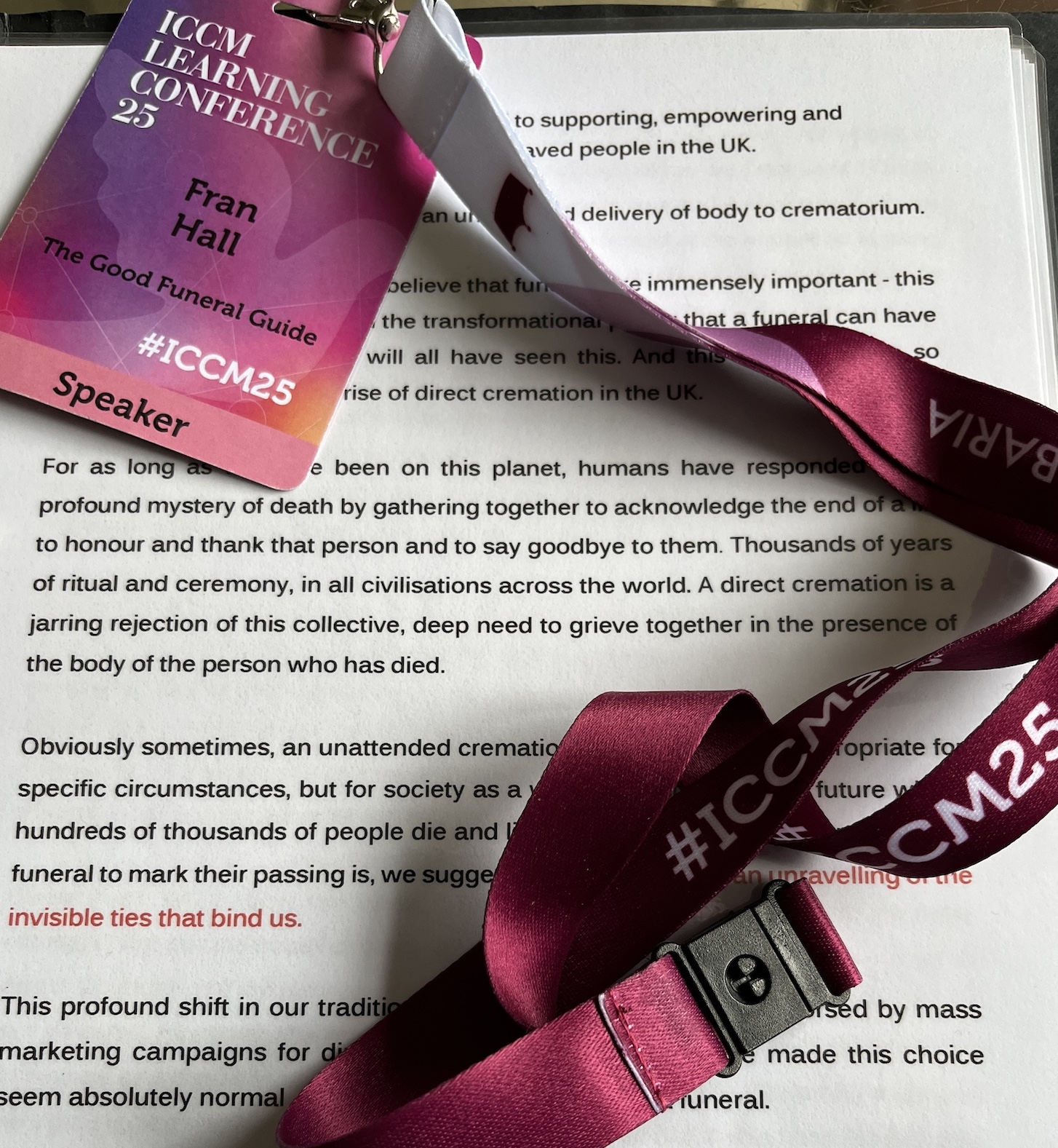

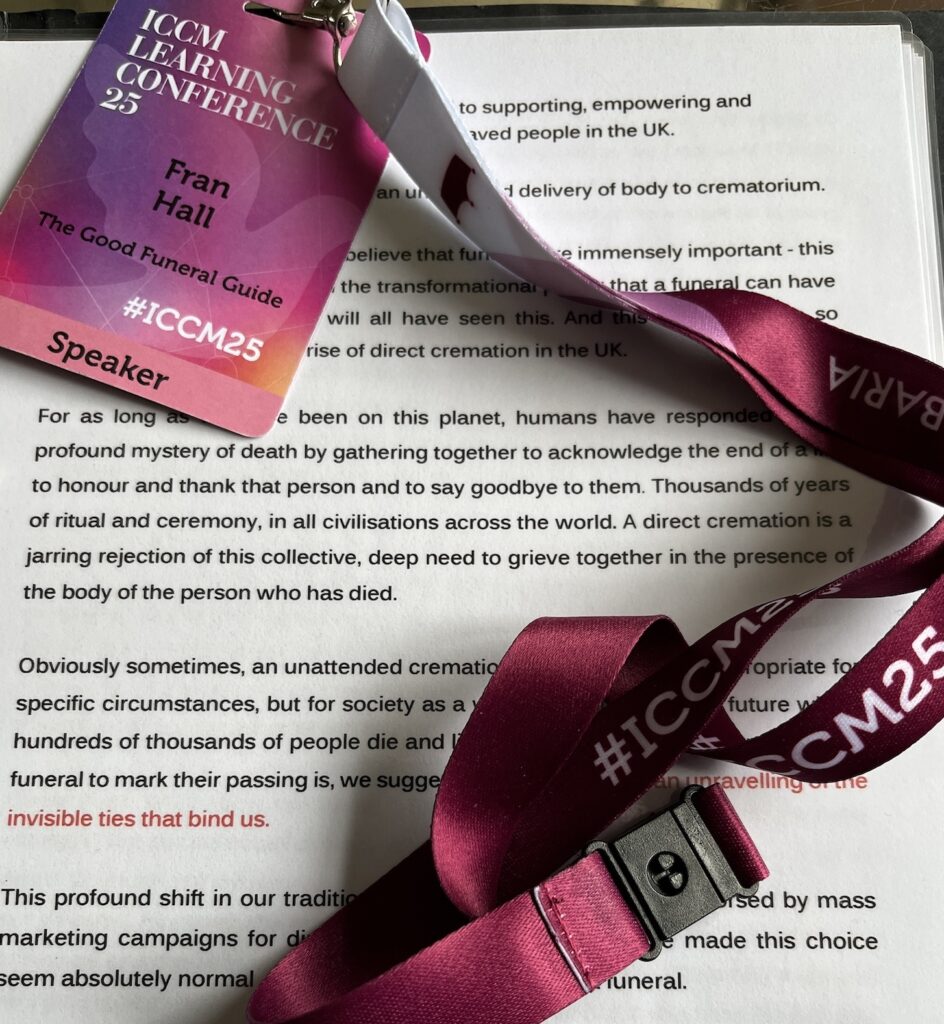
Yesterday, we had the great honour of being invited to take part in the closing debate at the ICCM Learning Conference in Warwickshire. The title of the discussion was ‘Affordable Choice, But at What Cost?’ and the subject was the rise of direct cremation.
Our task was to talk about the concerns we have at this big shift away from funeral ceremonies, while the case for accepting and embracing this change fell to the valiant Dan Garrett, former co-founder and CEO at Farewill, now Chief Growth Officer at Dignity Group. Dan stepped into the lions’ den with good grace, and fielded all of the questions in the Q&A (some quite challenging!) with much aplomb.
It was easy to set out our position, less so to fit it into the permitted ten minutes, which, unbeknown to me (as the delegated GFG representative) was shown on a massive countdown clock on-screen behind me. Slightly blinded by the spotlights, and juggling my reading glasses and notes, I was completely oblivious that everyone in the audience could see my time ticking away as I relied on my approximate timings from practising beforehand.
I’m sure I overran, judging by the look on the face of the lovely Mat Crawley, ICCM CEO, but he was kind enough not to admonish me. Anyway, we thought we’d share the notes used to keep on track for readers of the blog:
“At the Good Funeral Guide, we believe that funerals are immensely important – this is why we exist. We believe in the transformational power that a funeral can have when it is done well. And this is why we are so concerned about the rapid rise of direct cremation in the UK.
For as long as we have been on this planet, humans have responded to the profound mystery of death by gathering together to acknowledge the end of a life, to honour and thank that person and to say goodbye to them. Thousands of years of ritual and ceremony, in all civilisations across the world. A direct cremation could be seen as a rejection of this collective, deep need to grieve together in the presence of the body of the person who has died.
Obviously, an unattended cremation will be absolutely appropriate for some people and for specific circumstances, but for society as a whole to just drift into a future where hundreds of thousands of people die every year, without a funeral to mark their passing, is, we suggest, a sad indictment, an unravelling of the invisible ties that bind us.
This profound shift in our traditions is being encouraged and endorsed by mass marketing campaigns for direct cremation plans which have made this choice seem absolutely normal – in fact preferable to – having a funeral.
Just a few years ago, when funerals were so restricted by covid, we seemed to understand instinctively that we needed to have a funeral gathering and ceremony to grieve and commemorate a life communally, but we were prevented from doing so. Rightly, there was huge concern about how this might impact the mental health and wellbeing of those unable to attend. Yet now, it seems to be widely accepted that older people may opt to have no funeral when they die, and to be cremated on a date and at a time unknown instead.
We decided to look more closely into this, and we are running a questionnaire to collect real-life responses and voices of people affected by someone choosing a direct cremation. We have sent Freedom of Information requests to NHS Trusts to explore any potential impact on them with this change, which has elicited some interesting findings, and we have heard from Local Authority Bereavement Services deeply concerned at the impact on funding that the shift to direct cremation is bringing and the implications this will have on future provision of bereavement services.
Responses to our questionnaire suggest that cost is not the main reason for choosing a direct cremation, it is a factor, but less so than ‘not wanting a fuss’, or ‘specifically not wanting a funeral’. Clearly, many people no longer see value or purpose in a funeral ceremony, with ever increasing numbers persuaded by marketing messaging to select a direct cremation for themselves.
We think that the funeral sector must take responsibility for not changing as society changes, and not providing creative, affordable ways to add value. All the initiative for change lies with the disruptors, the private direct cremation providers. When it comes to promotion & marketing, they have created a neat sales package offering a low-cost, socially acceptable option where an inability to afford a funeral costing several thousand pounds doesn’t have to be raised.
One of the GFG Patron Ken West MBE wrote to us on this topic: “The real issue here is in how little we have changed the conventional delivery of funerals. Some funerals can take a lot of input, the more so if the deceased died at an early age and huge numbers of people are involved. However, the majority, those in their 80’s and 90’s, with few relatives or friends, or a desire for funeral wreaths or expensive memorials, can be arranged very quickly with little input. It ought to cost much less but it does not. Meanwhile, funeral directors are promoting add-ons like embalming, which is not necessary, and buying fancy hearse conversions when they could often use an alternative vehicle. Consequently, they spend more and then have to increase the cost of funerals to cover these costs. It is no wonder that the man and woman in the street has voted with their feet.”
We contend that funerals are for the bereaved – this is borne out by the people completing our online questionnaire, where 99% of respondents say the same. And yet choosing a direct cremation takes away this rite of passage from your family and friends, and the people and community who know and care for you.
Where someone has decided on direct cremation, going against the person’s wishes can be impossible for bereaved families, no matter how strongly they may feel the need for a marker in time and place, a ceremony crafted to help them articulate their grief and the rituals of saying goodbye with their community around them.
Even where the decision has been discussed beforehand, people don’t know how they will feel until the death has occurred. Deciding that you don’t want a funeral – however well-intentioned that may be – imposes your wishes on others, without awareness of any implications this may have. The possibility that upcoming reform of Burial and Cremation law underway with the Law Commission might make the wishes of individuals for what happens to their body legally binding on their families is therefore deeply concerning to us.
There is hardly any independent quality research on the impact of direct cremation on grief. A small study was commissioned and funded by Dignity in 2017. It was carried out by Dr. Kate Woodthorpe and others, involving surveys and interviews with 14 clients who had organised a direct cremation. The report from the study found that choosing not to have a funeral service at the time of the cremation did not result in a different grief experience to those that had a funeral service.
Findings from our questionnaire indicate very different results, with many people stating definitively that their grief was significantly affected.
In the some of the real words of real, bereaved people (not scripted for adverts):
“Personally, I have found it a surreal and lengthy process in coming to terms with him being gone. I feel an emptiness. Like his life didn’t matter and wasn’t remembered.“
“Really dissatisfied and incomplete. Friends didn’t know what to do. There was no coming together. It felt odd.“
“A lot of my family still feel like they don’t believe she died as there was no funeral to attend.”
“It belittled the relationships he had with those left behind as it felt as though it wasn’t important to them that those people got to express their feelings and share in their experiences and come together to remember and mourn their loss.”
“It felt impersonal, corporate and industrial.”
“My friend found herself wandering about not knowing what to do. Her brother’s wife also died a few weeks later and the same thing has happened.”
“It’s been very difficult to grieve as there didn’t seem to be a final goodbye.”
“I felt it was sad we were unable to remember collectively a life that had touched us all. My teenaged children struggled to process the passing of our relative without attending a funeral. My young adult child, in their early twenties, imagines the deceased relative to be working abroad, just pretending to be dead.“
“We are angry and dismayed that someone’s life can be ended this way with so little celebration. It has not felt dignified.“
“I think there is a lot of unspoken anger and sadness within the family that there wasn’t a funeral . This has prolonged the grieving process for several people.“
“It’s as if the death wasn’t totally real, so grieving was harder and more isolating. I still struggle with it now.“
There is evident need for independent, large scale, quantitative and qualitative academic research in this area to explore both the impetus to choose direct cremation, and the impact on bereaved people. We think the funeral sector as a whole should work together to commission and fund such research.
To close, it seems that we are in danger of slipping into a strange new world where older people perceive themselves and their lives to be not worthy of a funeral ceremony.
Would we consider a direct cremation for a baby? Or a child? Or a young person? If not, why not?
The mark of a civilisation is how it treats its dead.
A society that endorses the mass disposal of the dead without ceremony is not a civilisation that we want to live in.“
It’s a discussion we need to keep having, so many thanks to Mat and the ICCM for facilitating this opportunity to talk about the subject of direct cremation, and to Dan for being a charming and respectful opponent.
Couldn’t agree more. Well done and keep challenging this awful and unfulfilling practice. It’s meaningless and empty.
I wholeheartedly agree. Direct cremations are simply not right for the majority of people, but how do we convince them? I’ve had friends make this choice, ‘just put the money behind the bar,’ said my pal. He was an ex sailor, hugely popular, all of us were denied a chance to say goodbye, share stories and each others pain at his passing.
I’m not convinced so few respondents claim it wasn’t about the money. I don’t think many of us would like to admit we took the low-cost option.